Skip to content

Invertable functions ​

Most of the material for this topic was covered in previous semester's basic mathematics course. We will only briefly review the concept of invertible functions and their properties.

Link to basic bath materials: Inverse functions

Determining invertability ​

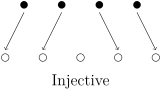
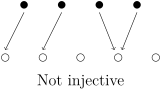
Function f is invertible if it is one-to-one or injective. This means that for every y in the codomain of f, there is exactly one x in the domain of f such that f(x)=y.

Details


So to chech for invertablility, we need to check if the function is one-to-one.

f(x1)=f(x2)⇒x1=x2

Inverse function ​

If f is invertible, then there exists a function f−1 such that

f−1(f(x))=xandf(f−1(y))=y

Example 1 ​

Let

f(x)=2x+13x−2:x∈(−∞;23)∪(23;∞)

be a function. Determine if f is invertible and calculate the inverse function and its domain.

Step 1: Check injectivity ​

Fix x1,x2∈Df where x1≠x2 and consider if f(x1)−f(x2)≠0.

f(x1)−f(x2)=2x1+13x1−2−2x2+13x2−2==6x1x2−4x1+3x2−2−6x1x2−3x1+4x2+2(3x1−2)(3x2−2)==7(x2−x1)(3x1−2)(3x2−2)≠0

So f is invertible.

Step 2: Calculate inverse function ​

We need to find f−1(y).

And determine Df−1=Rf, where

Rf={ y∈R | ∃x∈Df:y=f(x) }=={ y∈R | ∃x∈R∖23:y=2x+13x−2 }

First ​

Solve for x.

y=2x+13x−2y(3x−2)=2x+13xy−2y=2x+13xy−2x=2y+1x(3y−2)=2y+1x=2y+13y−2

So

f−1(y)=2y+13y−2

Second ​

Determine Df−1.

In order for f−1 to make sense, 3y−2 must be non-zero, so

3y−2≠0 ⇒ y≠23

But we also need to consider the domain of f.

x∈(−∞;23)∪(23;∞)

So

2y+13y−2≠23⇔2y+13y−2−23≠0⇔⇔3(2y+1)−2(3y−2)≠0⇔6y+3−6y+4≠0

which is always true ⟹ ignore it.

Conclusion ​

f−1(y)=2y+13y−2:( y∈R∖23 )

Example 2 ​

Let

f(x)=x+13x−2:(x∈[2;∞))

be a function. Determine if f is invertible and calculate the inverse function and its domain.

Step 1: Check injectivity ​

Fix x1,x2∈Df where x1≠x2 and consider if f(x1)−f(x2)≠0.

f(x1)−f(x2)=x1+13x1−2−x2+13x2−2==3x2−2−3x1+2(3x1−2)(3x2−2)==3(x2−x1)(3x1−2)(3x2−2)≠0

So f is invertible.

Step 2: Calculate inverse function ​

We need to find f−1(y).

And determine Df−1=Rf, where

Rf={ y∈R | ∃x∈Df:y=f(x) }=={ y∈R | ∃x∈[2;∞):y=x+13x−2 }

First ​

Solve for x.

y=x+13x−2y(3x−2)=x+13xy−2y=x+13xy−x=2y+1x(3y−1)=2y+1x=2y+13y−1

So

f−1(y)=2y+13y−1

Second ​

Determine Df−1.

In order for f−1 to make sense, 3y−1 must be non-zero, so

3y−1≠0 ⇒ y≠13

But we also need to consider the domain of f.

x∈[2;∞)

So

2y+13y−1≥2⇔2y+13y−1−2≥0⇔2y+1−6y+23y−1≥0⇔3−4y3y−1≥0

In order for the fraction to be positive either both numerator and denominator are positive or both are negative.

Therefore we need to consider two cases:

First case

{3−4y≥03y−1>0{y≤34y>1313<y≤34

Second case

{3−4y≤03y−1<0{y≥34y<13

Second case is not possible ⟹ ignore it.

Therefore, because y≠13, and y∈(13;34], final domain of f−1 is

Df−1=Rf=(13;34]

Conclusion ​

f−1(y)=2y+13y−1:( y∈(13;34] )